|
Our Consulting |
|

|
|

|
Design & Consulting Services
NIC consulting provides thermal management solutions to meet the specific needs of our customers. We recognize that companies are cutting back in many areas of their business, engineering being one of them. In order to reduce business costs, companies do not have the ability to add heat transfer engineers to their design teams nor does the current design engineer have time to take on new projects. NIC can quickly fill this void and provide instant knowledge of heat transfer design for many types of applications.
NIC Advantage:
- Instant knowledge of the global heat transfer market.
- Instant design knowledge (mechanical, structural, and thermal)
- Reduce cost through part synergy.
- Total Packaging Knowledge
- Utilize Pro-Engineer software for rapid prototype development and three-dimensional modeling for use in customer applications.
- Utilize secured X-Drive technology for quick and easy transferring of large data files.
- Product testing requirements knowledge (Vibration, Thermal cycling, and pressure cycling)
- Programs supported COE (Center of Excellence), VAVE (Value Add Value Engineering), FMEA (Failure Mode and Effects Analysis), DFT (Demand Flow technology)
Customers in the following markets rely on NIC Heat Transfer for their thermal management needs:
Testing
Testing Capabilities:
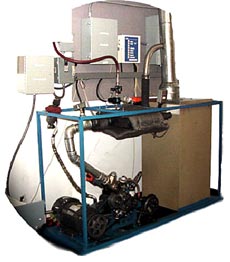
NIC has access to an advanced testing facility available for the development of new products
The testing facility covers the below mentioned 4 main fields:
- Development, specification and documentation of new cooling systems
- Development and verification of design programs
- Performance testing and problem solving on prototypes / new products
- Life tests of new products before production runs
NIC's laboratory complies with the demands of the QS 9000 and ISO standards. Testing is according to international standards and the measuring equipment is calibrated by accredited laboratories.
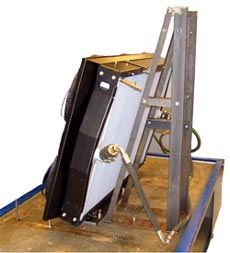
The testing facility complies testing of pressure cycling, vibration cycling, pressure loss, thermal performance and thermal expansion.
|

|